7 of 30 - Stinging Sensations
Jun. 29th, 2010 10:29 pm![[personal profile]](https://www.dreamwidth.org/img/silk/identity/user.png) aggienaut
aggienaut![[livejournal.com profile]](https://www.dreamwidth.org/img/external/lj-userinfo.gif) emo_snal.
emo_snal.But first, I accidentally left out an important detail about my last entry about the Walmart in Aberdeen -- the Walmart in Aberdeen recently BOUGHT OUR DOCK!! Crew response to this news: "...you mean.. we have nowhere to dock in aberdeen now? .... HOORAY!!"
And now on to our feature presentation!
Stinging Sensations
I spent this evening reading about ants on wikipedia, because I'm a nerd like that. Ants you see are extremely closely related to bees (relatively speaking. they're in the same Order (Hymenoptera)) so I'd been wondering for awhile if they exhibited a number of traits I know bees have.
It turns out that new queen ants do go on mating flights (yes flights, the queens and male drones are born with wings) just like bees. Then the drones die (just like bees). Unlike bees though then every mated queen ant finds somewhere to start a nest by herself. Digs a hole and starts laying eggs.
Read up on army ants. Apparently we have them in the United States but no one notices because the species here are smaller and travel in smaller swarms and mostly at night. In Africa "driver ants" can kill people ... but they only travel 20 meters an hour so one can usually escape. There are species of birds that specialize in eating the insects fleeing in front of moving army ant swarms in South America ... and species of insects that specialize in eating the droppings of these birds!
One thing I didn't know about army ants is many species, particulary the archetypical one have no permanent nest. They make a nightly nest out of the living bodies of their workers!!
Also: "Members of the species has been observed using their bodies to block potholes in a path between the nest and prey. The ants will each walk to a hole and measure themselves to see if they are a fit for it and if they are, will lie across the hole to allow other members of the colony to cross at higher speed."
Jack jumper ants (not a type of army ant) in Tazmania have a sting that can be lethal to humans and annually cause more deaths in Tasmania than spiders, snakes, wasps, and sharks combined! (such sauce!!)
And speaking of stings...
Schmidt Sting Pain Index (full article)
This (completely mad?!) scientist named Justin Schmidt apparently made an index of the level of painfulness of 78 species of Hymenoptera. This of course begs the question ... did he purposefully get himself stung by all these insects?!?!
His reviews read like he's reviewing gourmet food or a fine wine:
1.0 Sweat bee: Light, ephemeral, almost fruity. A tiny spark has singed a single hair on your arm.
1.2 Fire ant: Sharp, sudden, mildly alarming. Like walking across a shag carpet & reaching for the light switch.
1.8 Bullhorn acacia ant: A rare, piercing, elevated sort of pain. Someone has fired a staple into your cheek.
2.0 Bald-faced hornet: Rich, hearty, slightly crunchy. Similar to getting your hand mashed in a revolving door.
2.0 Yellowjacket: Hot and smoky, almost irreverent. Imagine W. C. Fields extinguishing a cigar on your tongue.
2.x Honey bee and European hornet: Like a matchhead that flips off and burns on your skin.
3.0 Red harvester ant: Bold and unrelenting. Somebody is using a drill to excavate your ingrown toenail.
3.0 Paper wasp: Caustic & burning. Distinctly bitter aftertaste. Like spilling a beaker of hydrochloric acid on a paper cut.
4.0 Tarantula hawk: Blinding, fierce, shockingly electric. A running hair drier has been dropped into your bubble bath.
4.0+ Bullet ant: Pure, intense, brilliant pain. Like fire-walking over flaming charcoal with a 3-inch rusty nail in your heel.
Now, knowing this, when I later came across a live tarantula hawk I was naturally quite excited. And of course, my immediate thought was "I need to get a picture of this thing on me!!" I quickly used my insect-whispering skills and got her to run up my arm: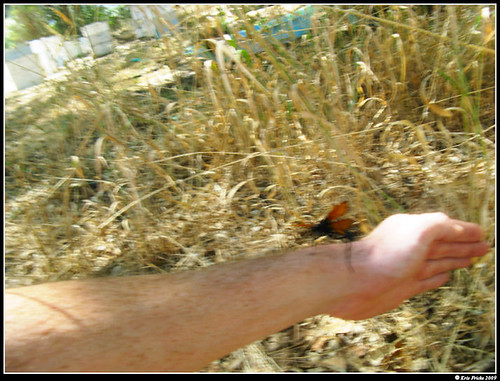
Not the best picture but it at least gives an idea of the wasp's size.
These things hunt tarantulas, hence the name (for those of you from far and wide, I don't know if everyone knows what a tarantula is, but it's a hairy spider the size of a plate).
The sting of a tarantula hawk has been further described by Schmidt as having "an immediate, excruciating pain that simply shuts down one’s ability to do anything, except, perhaps, scream. Mental discipline simply does not work in these situations." and you'll notice the lovely Shmidt Sting Pain Index referenced above rates it the second most painful insect sting in the world.
It was running along the ground at the time so I put my hand in front of her and she hopped aboard! Unfortunately she was still moving pretty fast so I only got one kind of blurry picture before she ran all the way up my arm and disappeared behind my neck before taking flight.


![[identity profile]](https://www.dreamwidth.org/img/silk/identity/openid.png)
no subject
Date: 2010-06-30 06:09 pm (UTC)no subject
Date: 2010-06-30 06:10 pm (UTC)