Apinautica Chapter 11 Pt 2
Nov. 26th, 2025 07:21 pm![[personal profile]](https://www.dreamwidth.org/img/silk/identity/user.png) aggienaut
aggienautJune 28th, 2014 - By and by we begin to descend, and Guinea materializes as a landscape seemingly devoid of human development, an endless expanse of wetlands, a tangled criss-cross of rivers and damp-looking foliage, until suddenly the long narrow capital of Conakry, jutting out on a peninsula into the ocean, appears below seconds before landing.
While deplaning I get to talking to a woman from Doctors Without Borders who is here to help fight “the worst ebola outbreak in history,” as she describes it. “It’s completely out of control!” she adds confidentially. Hmmm well great.
Outside the terminal it's hot and humid, and there are the usual throngs of pushy porters trying to help me (for a fee) and taxi drivers insistent on taking me whereever I need to go, but I’ve both been through this before and plow through the crowd to the two staffmembers from The Organization (identifiable by their hats), a young man and young woman, and load my things into the Organization's landcruiser.
Conakry seems more like a large village or expansive town than a city. Previous African capitols I've been in (Abuja, Addis Ababa) are at least characterized by paved streets and big buildings, but across the street from the airport there are houses with corrugated metal roofs, and dirt roads with streams of filthy water running through them. Not quite shantytown, more "functional squalor." The Lonely Planet guidebook describes Conakry as "smelling nausious" in general but the misty rain must have been dampening that effect. We wend our way around throngs of children playing soccer. World Cup fever is in full swing.
Total travel time: 28 hours. Hotel is decent -- the AC works, the power hardly ever goes out, and the internet usually works, what more can one ask for?
“There won’t be any banks up-country, so you’ll need to have all the project funds with you,” Mamadou Th. from the Organization tells me as he begins handing me several bricks of rubber-banded bills. “So this is the $2.8 million Guinean francs.”
“Haha, what! How many dollars is this?” I ask, ogling at the amount of money.
“$414. The largest bill we have is the 10,000 franc note, which is a dollar forty-eight.” He departs leaving me with these bricks of cash on the table, feeling like a drug lord. I look in the usual places safes are hidden (the closet), but there appears to be none! It would not do to submit roomkeeping to the temptation of several years of salary just laying around.
My gimlet eye alights on a pertinent oddity – there’s no safe, but there’s a lock on the room mini-fridge, with a key in it. I remove the water bottles and stuff my cash and laptop into the fridge before heading out to look for a restaurant, surprisingly therere’s a Turkish restaurant a short way down the street. Merhaba, merhaba.
Back in the room in the evening, I pull my laptop out of the fridge to write up some notes and receive an un-asked-for science lesson. Almost immediately, the hot, humid air forms great droplets of cool water on the smooth black laptop. The laptop has burst into tears at the absurdity of the situation, and they flow down its sleek sides and plop sadly to the floor. I nervously eye the drops near its vents, threatening to choke it on its own tears. I’ll need to give it some time to collect itself and acclimate before writing any reflections. I unplug the fridge to prevent any further violations of the natural order of fridges and laptops.
I have a few days in the capital. Pounding rain alternates with steaming sunshine, kids kick soccer balls around on streets potholed with mouldering puddles. I meet another volunteer just finishing a project, as he stumbles back into the hotel after being held by the military/police (gendarmes) for a few hours because he’d taken a picture of the statue in front of the military barracks down the street, and he was only released after he gave in and bribed them $50 to release him. He soon departs to head back home, but I also meet another volunteer who is going up-country at the same time I am, Edie, an older woman who does business development.
Graphs of ebola deaths keep rising. Ebola is here in the capital but not out in the countryside where I’m going, which lends a feeling of particular urgency to escape the fetid capital. Finally on Tuesday morning The Organization’s car arrives. They have a new driver, they explain, because the previous driver died on Saturday.
[okay HERE begins the new part]
It’s twelve hours drive from the Conakry to our destination in the interior. The first four hours alone of that is slogging through the capital where despite an early start the traffic is bumper-to-bumper in the early light. Water fountains onto the road from the dilapidated surrounding buildings, and the potholes are so big that we pass one in which a car has fallen in so deeply that its back wheels are now off the ground leaving it stranded like an upside-down beetle. Obstacles like this do nothing to improve the traffic.
Once out of the city there’s much less traffic though the road is under construction for large sections. By and large it seems to wind up an narrow valley the entire way, the surrounding hills and valley floor filled with palm trees and jungley foliage. We pass through occasional village of huts steaming in the morning sun, or the jumbled corrugated roofs of a small town with a chaos of little market stalls fronting the main road. The occasional old colonial building stands decaying in the center of a town, green with with moss or algae. The further into the interior go the less women wearing jeans are seen and the eventually women in full burqa begin to be seen.
We frequently pass small roadside stands selling bottles of some red liquid. Wondering what this popular beverage is I ask the driver – it turns out this is how they sell gasoline here.
Finally after a long tiresome day of bumping along these bad roads just a short distance outside the larger town of Labe we turn off the paved to drive ten minutes or so down a rural dirt road until we arrive at a low wall with a metal gate that children excitedly push open for us, and we drive into the center of the village of Sanpiring.
This village is very orderly. Villages I’d seen in Nigeria had been awash with discarded plastic festooning every bush and carpeting the ground like a hideous autumn leaf-fall, not here. The village consists of mostly small concrete-brick houses with corrugated roofs, though there’s a few huts, and the houses are surrounded by their small fields of corn or cassava. The paths between them and the broad driveable passage to the central square are covered with uniform clean volcanic gravel – an important touch since the constant rain doesn’t puddle or make mud of the gravel. The entire village is surrounded by a low wall, outside of which the flocks of goats graze in a green countryside of meadows of forests. There’s no sheds, outbuildings or tools left outside the wall, it’s a very definite dividing line between civilization and complete wilderness.
“We used to have a Peace Corps volunteer here named David” someone mentions to me during my first tour of the village, translated by Baro, “but he died.”
There’s a spare room for me available in one of the houses, it even has a western toilet! Though I feel kind of guilty that every time I flush it some kids get sent to work the pump and manually bring buckets of water to refill the cistern.
My local host has a slight stature and boyish grin, though the lines on his face make him look old, and altogether its hard to place his age, as life here can age one’s face prematurely. Nearly none of the local villagers speak French, much less English, so I’ll also be accompanied by an interpreter, Baro. Baro is older, stolid and serene, though he walks with a distinct limp due to having been hit by a car years earlier. Not at all evangelical about it or pushy with righteousness, he glows with real pleasure when he talks about the traditions of his Muslim faith. It’s Ramadan and he earnestly mentions the value he finds in fasting, without seeming for a moment to judge me for my decision not to fast.
Walking to the hives he suddenly bends down and plucks a herb: “This is very good for blood pressure!”
“This is very good for digestion!” he had says later about a different herb.
“This is very good for achy joints” he declares still later, proudly holding another sprig of foliage. And then he acquires some aloe vera, somewhere, and attributes all of the above and more to it. Thereafter every day after the breaking of the fast he carefully, lovingly, slices off a sliver of his tapered aloe vera blade and eats it like the sacred wafer.
Seventy percent or so of the beekeepers I’m training have “Mamadou” as a first name. So many have “Bah” as a last name, looking at the attendance list I at first assume that’s just the local word for man. The names “Diallo,” “Alpha,” and “Yaya” in various combinations make up the remaining 30% of first names or the middle names. They wear either nice traditional fabric clothes or clothing they evidently got from a Salvation Army shipment from the States. One of the beekeepers in has a green "SMHS CHEER" jacket. Another had a shirt ostensibly advertising a 5k in Scantron, Pennsylvania, but being as it also has among the list of causes "celebrity rabies" I suspect it may have something to do with the show The Office. Another has a shirt emblazoned with "Alabama State Youth Beef EXPO 2009" and another, almost certainly Muslim man, wears a shirt for some American church, no doubt unaware of its meaning.
Over the next several days a happy routine develops. I awake to the sound of roosters, with no reference to a clock. Upon emerging someone soon hands me a fresh baguette (not baked in this village but a nearby one), and some barely palatable nescafe (but that’s on me for having somehow become a coffee snob. Even in Australia, a place proud of its coffee culture, it’s considered fine and normal to offer a guest a “cuppa” of execrable nescafe). One by one the trainees show up until we feel we have enough to start – again with no reference to a clock, this is Africa time!
We have classroom sessions in the morning, outdoors if its nice, indoors in a small community hall (in later years it had been turned into a house but in 2014 perhaps it was just conveniently unfinished and suited the purpose), sometimes having to take breaks if it was raining so hard we couldn’t hear ourselves. Sometimes we plug in a generator to show some informational slides and everyone (myself included) plugs their phone charger into the rare source of electricity. In the afternoons we go out to the hives that are here and there in copses of trees in the village’s immediate surroundings. Usually not the whole group but a different half a dozen or so. We sweat in the beekeeping coveralls in the humid heat, and can’t overly exert ourselves because everyone is observing Ramadan and therefore fasting. Upon return to the village, one particular six year old, Mamadou de Boba, has taken it as his sacred duty to carry the smoker.
In the evening Baro and I sit on the porch of the house we’re lodged in, reading and listening to the transistor radio, our one link to the rest of the world. The Ebola outbreak continues to get worse. It hasn’t arrived in this prefecture yet but there’s a few cases in Conakry – what if I can’t get back out through Conakry? I’d have to exit through unstable Mali or a really really long journey through Senegal to the north. Baro, himself had been born in Timbuktu in neighboring Mali, but as radical insurgents flying a sinister black flag had taken over that portion of Mali, he is now temporarily displaced to Guinea. In happier news the radio also keeps us informed about the World Cup.
The children all run laughing amongst the huts like a school of minnows. Mamadou de Boba never tires of talking to me in the local language (Pullar), to which I absently respond “mhm, really? You don’t say.” and he happily carries on. As the adults come in from their day of work they greet their siblings and cousins and inevitably end up gathering on someone’s porch chatting into the evening.
Baro slowly makes tea by pouring the brew repeatedly between a cup and kettle as the stars come out above us and the only light that remains is the glowing embers under the kettle and lightning flashing on the horizon. The call to prayer rings out from his phone and with a genuine smile Baro says “come let us break fast” and we join the procession of people walking by flashlight along the narrow paths hedged in by corn to the little village mosque.
There people would hungrily eat a millet soup before praying, and then after we’d walked back to the house it was usually still an hour (again, of conversation, tea, the light of glowing tea-heating embers and distant lightning) before dinner would finally be ready at around 11, usually meat and rice in one large platter everyone would eat from with their hands, in the near dark.
Ebola is spread by contact with any bodily fluids. I often feel acutely aware of this as I watch half a dozen other people around me putting a mouthful of food in their mouth and then reaching that same hand back into the communal food platter. Does this stop me from participating though? No, although I do use as spoon as I just can’t get the hang of eating with my hands. Finally go to bed and fall asleep to the sound of pounding rain. Wake up to the crowing of roosters and repeat of the process.
I’ve been told they want a lesson on business and marketing. This causes me disproportionate stress – I’m by now confident I can teach beekeeping to everyone’s satisfaction but who am I to teach business? Putting it off to the last day is a good way to at least procrastinate addressing the subject.
Finally it can’t be put off any longer. I put together some notes, we gather indoors because it’s another rainy day and … much to my surprise and relief, Baro, to whom I’ve expressed my misgivings about having much to contribute on this subject, thoroughly steps up. He’s acted as interpreter for several business development projects in the past. Baro, this serene displaced Malian nomad, as always in his traditional patterned fabrics, stands beside the flip board I’ve barely used and fills it with page after page of flow charts and cluster-diagrams and key words. I take a lot of notes, ideas and concepts which will be used in my presentations ever after. When we’ve finished and he hobbles out of the building, he notices a herb by the path and plucks it excitedly, informing me of its medicinal properties. Truly a man of many parts.
One afternoon I explore the surroundings of the village accompanied by Mamadou de Boba, my six year old squire. I try to instill in him an appreciation of insects but unfortunately, with no language in common, he usually interprets my pointing out an interesting insect as an invitation to smash it. There’s a river not far from the village, and another boy of around nine shows us a place on the bank where you can pour a bucket of water and it will disappear down some holes and reappear from others as it runs down to the river. What fun! We enjoy these boyish hydrography games for a good hour, before returning to the village, wet muddy and happy.
Rather to my mortification I arrive at the house in which I’m staying, still wet and muddy, to find the beekeeping federation president and his wife, dressed nicely and sitting primly inside. They’d apparently come on a rather formal visit to see me and showing up late wet and muddy I suddenly felt like an ill-behaved child. Things didn’t improve when the beekeeping president’s wife said she was inviting us for dinner and was preparing fish – which I was prepared to try to have a go at again but Baro promptly noted that I dislike fish.
We do later catch up with the federation president and his wife, and most significantly he asks if I plan to attend the African Beekeeping Symposium in Arusha, Tanzania, coming up in November. Well no that hadn’t been on my radar, but now that you mention it I might consider it.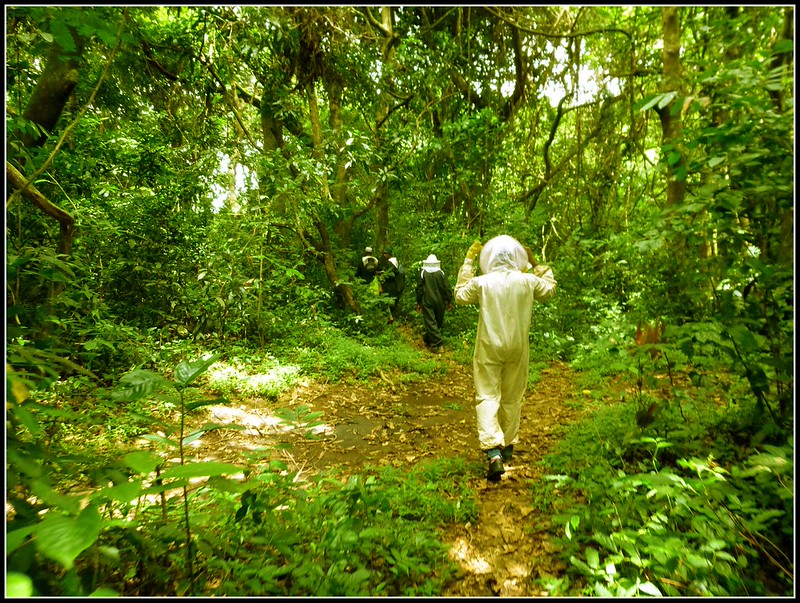
Another afternoon after our work for the day has finished I decide to walk out to a nearby part of the river where it passes over a large rocky area and forms a number of pools, and the village women do their washing there. In fact I had aborted an earlier attempt to explore the area when from a distance I saw that the village’s women were doing the washing there – topless.
On this pleasant sunny afternoon I set off down the village paths in that direction. As I turn to close the simple wooden gate I see a teenage girl coming along behind me and hold the gate open for her. I then proceed in the direction I intend, but coincidentally the girl seems to be going the exact same direction. I maintain my pace an remain a few steps ahead of her, lest it seem like I’m following or accompanying her to wherever she’s going, but she remains on the same route as me as I leave the village behind and pass the outlying copses of trees.
Finally we arrive at the washing place. I turn to look at her – it turns out she didn’t come here to do any washing either. She simply comes to a stop facing me, brazenly looking me in the eye with a mischievous smile. Well this is awkward.
“Comment t’appelle tu?” I ask dredging up my mediocre French.
“Mamanou” she responds.
“Um…” I dredged my mind for another question I could ask in Fernch.
“Quel âge as-tu?”
“Dix-sept ans, et tu?” but unfortunately the answer to her question, 32, is beyond my French, so I try to indicate three sets of all ten fingers plus two, I’m not sure she understands but she giggles.
Well I admire her brazen pluck, but she’s too young for me and just disappearing out in the bush with her for any period of time could lead people to think things, so after only briefly looking around the rocks we head back to the village, albeit walking side by side now. I’d like to make conversation but unfortunately I don’t know nearly anything else worth saying in French, and her understanding of French may have been exhausted as well, as, again, most people out here only speak Pullar. Safely in sight of the village just outside the gate I show her pictures on my phone of life in California.
The next day, the last day of class, another girl, one of the few in the beekeeping class, palms me a note that says “I love you.” Psh, not nearly as ballsy as Mamanou. The Organization Landcruiser has returned and Baro and I depart, the entire village and all the trainees lining the car’s path out of the village, enthusiastically waving.
That afternoon we only make it halfway back to the capitol. At the hotel I’m excited to finally take a shower for the first time in ten days, eagerly awaiting the turning on of the water heater in the evening. Unfortunately, when they finally do, I find it has no setting other than scalding so the best I can do is steam myself.
The next day we make a short detour to see a tall and beautiful waterfall, one of probably many around the world known as “Bridal Falls” (“La Voile de Mariee”). Its beauty will haunt me as a ghost as by the next year already illegal loggers had strip logged the area leaving just a sad devastation.
As we approach the capitol we pass convoys of white landcruisers emblazoned with red crosses headed inland and billboards advising safety precautions against Ebola, then approaching its peak. Nearly 80% of those infected with ebola will die, often horribly bleeding out of their eyes and ears.
Checking into the hotel in Conakry I’m excited to finally finally take a decent shower. I get in the shower, turn it on and … the showerhead shoots off like a rocket barely missing me but bouncing off the shower wall with a clang as water sprays everywhere.
The next day I’m in the Organization office to meet with USAID officials, who were supposed to show up at 11:00. Another volunteer who’s project had also just ended keeps saying "they won't come, they never come" but around 10:50 they say they are running a little late but were on their way. I feel tired and my back aches. They update us again at 11:15 saying there was bad traffic ... and finally after 11:30 it’s announced they aren't coming at all. Were they ever coming? One of life's great mysteries.
I accompany the other volunteer to a place where souvenirs are being sold and buy two decorated horns and a large wooden spork, though really I just want to go back to the hotel and rest as I’m feeling fatigued.
July 15th, 2014 - I find myself lying my my hotel bed aching, as the rain patters serenely on the windows and the beautiful ethereal call to prayer warbles throughout the city in the pre-dawn darkness. My back aches, I have a sore throat, a runny nose … what are the initial symptoms of ebola? Aches, a sore throat, a runny nose… I lie there through the last hours of the night thinking about this very emphatically.
Reporting to the health authorities would be the responsible thing but also sounds like a good way to end up quarantined with people who definitely have ebola or something. We have a family friend however who is a doctor who has specialized in exotic tropical diseases. I talk to him on the phone and he seems confident I do not have ebola. And I’m an optimistic person, in a country of twelve million what are the odds of me being ebola case number 407?
As I enter the airport that evening I find myself trying very hard not to look sick. They aren’t carefully examining everyone but there's someone in a white doctor’s coat watching everyone enter – I make it around the corner before having my next fit of coughing. Another hour sitting by the gate trying not to blow my nose too much or otherwise arouse suspicion, and finally running the gauntlet of boarding with my best appearances of not being sick. It wasn’t until we were safely in the air and bound for Europe that a different concern began to niggle at my mind – what if I did have Ebola? And I was now spreading it to Europe?
After covid I know intentionally trying not to get quarantined seems like distinctly amoral behavior but in a country where all infrastructure is crumbling, festering and unsanitary you go and volunteer to be put in whatever they call an ebola quarantine. Also looking at contemporaneous livejournal entries I don't think I'd written about the incident with Mamanou, I think because it seemed questionable to dwell on at all, and I'm still on the fence about omitting it in this memoir but after all I did nothing wrong and it represents something of the kind of moral hazards one can face. Also this isn't the last she appears.
Whereas previous trips I've separated events into the days they happened this one I've experimented with running everything together.


![[identity profile]](https://www.dreamwidth.org/img/silk/identity/openid.png)
no subject
Date: 2025-11-26 10:25 pm (UTC)I've heard a Senegalese musician named Mamadou.
no subject
Date: 2025-11-26 10:47 pm (UTC)no subject
Date: 2025-11-29 11:59 am (UTC)I'm glad to see you posting in your memoir again.
Congrats and Happy Anniversary!
- Erulisse (one L)
no subject
Date: 2025-11-30 03:06 am (UTC)