aggienaut: (Default)

   I think Elon has tweaked the twitter algorithm again, for the last week or so my feed has been mainly lame engagement-bait. I had earlier tried to get into the twitter-alternatives but none of them felt like they had as vibrant of discussion, but I don't know he might have finally completely killed the vibe.

   Also a lot of discussion these days has been about AI. One particular favorite on my feed is screenshots of "AI Artists" complaining about things like not getting taken seriously, and there was one very funny hit tweet this last week of a screenshot of an "AI Artist" complaining that it was too hard coming up with prompts and they should make a feature that comes up with prompts for them!

AI-02.jpeg

   Here's the thing, as I see it, art is art because when we see it we take a moment to stand in awe of either the technical skills of the creator, or the creator's stunning original thinking and insight, or, often, both. For example a photorealistic painting painted during the rennaissance was awe inspiring, that exact same image captured with a phone camera in 2025 would garner no reaction because it doesn't show case technical skill, unless of course the composition is clever and insightful. Even if it's beautiful, we appreciate it because the photographer managed to be in the right place at the right time and had the insight to catch it, whereas an AI "beautiful scene" we know no one had to put any particular effort into being anywhere in the right place or the right time. As such, AI "art" is not art.

   And that's not even getting into the fact that it's a theft machine. Every time AI does come up with something that looks like actual art there is almost inevitably an original human-made work it just ripped off. AI "art" machines are fundamentally incapable of original work.

AI-01.jpeg

   When it comes to writing, it could be a useful tool in the right hands, as long as the person using it is using it as a tool to express their insightful idea, IN THEORY, if it was better. I have written about my attempts to work with it to write this Star Trek parody but ultimately it required so much intervention on my part it was not worthwhile. But I could imagine if it was better at learning to copy my own personal style after I had spent some hours going back and forth with it that it could eventually become a tool that accurately reflected my original vision on a work .... but it's not nearly there yet. Every single time I've asked it to write something for me to see how it did, it came up with something that was wholly unsatisfactory to me.

   Obviously there's a lot of people who's own innate writing ability is worse than chatgpt's and I guess it seemingly helps them seem like better writers, but I still think they'd be better off continuing to practice. Already I'm getting emails that, while directed to me personally about something we were talking about, are just so perfectly professional I'm like ugh you let "Gemini" or whatever write this for you didn't you. If the people pushing AI into every digital product do succeed in getting people to use it for nearly everything, I can really see it genuinely dumbing down the population into being unable to write anything longer than a "prompt"


   What I do find it genuinely useful for is quickly collating information, like working on a magazine article I came across a spreadsheet of types of almonds planted in the most recent year, some varieties are self pollinating, most are not, I could spend an hour manually adding up the totals or take a snip, ask chatgpt what percentage are self pollinating... and then if at all possible check it's answer for errors! I have often found it can somehow hallucinate one number in a spreadsheet for another! But eventually you get an answer. Like with the writing this isn't just ask it one prompt and run with the answer, it requires some back and forth to get things right, it's a god damn tool.

   I had a funny interaction just the other day. I was looking for historical background on Kenya for the memoir work (sorry it's photos of my screen instead of screenshots):
ChatGPT-01a.jpg
ChatGPT-01b.jpg
ChatGPT-01c.jpg
(yes I talk to chatgpt like I'm talking to a person, because I think it would be mentally unhealthy for ME to do otherwise)

   Don't feel like I'm dealing with a super-intelligence here. But even something like this, note I knew exactly what I was looking for, I had to shove chatGPT's face into it, AND, fortunately, I have actually read the Rihla before so I was able to discern if it was hallucinating the passage or not, and in this case what it reported matched my recollection. People who aren't smart and try to use chatGPT to pretend they are are just going to end up in la la land.
   Several times I've had someone try to win an argument about some beekeeping topic with me on facebook by posting a long chatgpt explanation of their position. When I poke a bunch of holes in it and chastise them for using chatgpt they usually slink away in shame. ChatGPT is not an expert on any topic, it's more like a drunk guy at a bar pretending to be an expert but willing to confidently tell you details it just made up to maintain the illusion of being smart.

aggienaut: (Default)

   Okay this is the final act of the pilot, hopefully it just took me this long because I was retraining the AI to my most exacting standards and/or I cared particularly about what happened, because unlike the other episodes where I literally gave it a prompt and it gave me an entertaining story this took so much back and forth I could have written it entirely myself in that time, and really I shaped the plot so exactly all that remains from the AI's "original" input is the phrasing of people's lines and SOME of the fictional induction units but not even a majority of those.

   But in other news I finally contrived to watch Star Trek Lower decks (there are far too many streaming networks!) and unlike Orville (and "Utopia" which I also recently tried to watch) I find it to be actually pretty funny.


   The onboarding room is windowless and beige, with a low acoustic ceiling and a faint smell of sterilized upholstery. A carafe sits untouched on the table.
   On one wall hangs what appears to be an oil painting, though closer inspection reveals it is of course a cheap copy of one. It depicts a weathered hunter, horn to lips, eyes locked on something distant. Below him, in cracked gold letters:
   “Raphèl mai amècche zabì almi.”
   Rafael reads it twice before giving up. The room feels like it has been borrowed from a dental seminar on a less stylish moon.
   “But what if we ran a test,” a Ferengi named Quid is saying. He has expensive boots and a memo pad tucked into one sleeve. “List it once under ‘sandwich’ and once under ‘entrees.’ See where it sells better. That’s the category.”
   “In Sweden,” says Haakon Svenson, leaning back with his boots on the conference table, “we have korv med bröd, and no one calls it a sandwich. It is… its own thing. Like a poem. Or an uncle.”
   “It’s clearly a sandwich,” says Wesley Crusher, upright and vibrating in a freshly pressed red uniform. “I ran a starch-to-protein ratio sim last night. Optimal bun distribution is within standard deviation for known sandwich types. I even developed a new optimized klein-bottle shaped hot dog, I’ll show you!”
   He reaches for his pad, but stops when the klingon Waffel, with the gravitas of one who would think nothing of settling an argument with a blade, growls “It is tradition that a hot dog is not a sandwich and to say it is is dishonorable,” looking from face to face daring someone to argue.
   Seated with the quiet poise of someone who does not expect the world to make sense is Søren Kierkegaard, cradling a ceramic cup. He doesn’t appear to be listening. A spiral-bound pamphlet titled Ethical Boundaries in Recreational Holodeck Use: A Tiered Approach lies open in front of him. He turns a page slowly.
   Rafael finds a seat between Quid and an anxious young man with a gaunt, Dickensian sort of face. The latter offers a faint, apologetic smile.
   “Please sir, Philip Ignacio Pirrip – they call me Pip. Do you feel as lost as me?”
   Further introductions are interrupted as the door opens with a hiss, and Dirxana enters with a clacking of high heels, holding a laser stylus like a scalpel.
“   Welcome, new crewmembers,” she says, enunciating each syllable like it had wronged her. “I recognize many of you from your interviews” she continues with a sharp toothed grin. Pip turns red and slumps in his chair as if he’s trying to hide under the table. “Thank you for volunteering” at this Haakon seems about to object but thinks better of it.
   After a moment of silence calculated to make Haakon feel awkward, she uses her laser-stylus to put a red dot on the blank presentation screen,, then methodically moves it up and down while watching the attendees. Just as it seems like someone is about to ask what she’s doing she continues.
   “Good, I’ve confirmed that your eyes are functional. You will be asked to sign a waiver acknowledging potential retinal fatigue, and we’ll continue with exactly eight hours of powerpoint induction videos”
   She clicks a remote. The screen at the front lights up with a menu of training modules, each more tedious than the last. Titles include: Proper Disposal of Personal Matter on Ships with Temporal Anomalies… Stairwell Etiquette During Hull Breaches… Smiling in Multispecies Contexts… and Password Management in the Post-Trust Era.”
   “Welcome to your formal orientation aboard the USS Nimrod. You are now part of a team committed to exploration, diplomacy, and the efficient filing of incident reports. You will begin your career with thirty-nine onboarding modules.”
   The wall screen flickers to life. The holographic presenter— grinning insincerely with stock-photo-model perfection, and dressed in cheerful shades of teal—gestures with unsettling confidence toward a holo-slide labeled “Welcome to the SpaceFleet Family!” under which is a topologically impossible looking diagram seeming to imply a closely interlinked relationship between “Team Values” “Galactic Peace, Prosperity and Stakeholder Synergy,” “Correctly Filing Expense Reports” “Exploration” “Exceeding KPIs,” and “Inspirational Mindfulness in Emergency Scenarios.”
   “Hi! I’m Clippy,” says the man, as if they’re old friends. “And I’ll be your Onboarding Bestie™!

   Several hours later Rafael has entered a delirious fugue state, as the ever cheerful never-tiring presenter is explaining with impossible levels of enthusiasm
   “…To file an expense report, simply navigate to the SpaceFleet Interagency Resource Nexus for Unified Budgetary Access and Logistics—that’s SIRNUBAL dot fleet dot core dot fiscal dot hr dot morale dot net.
   From there, hover over the third dropdown labeled ‘Financial Interactions’, and click the seventh option, ‘Asset Reconciliation & Related Initiatives’.
   On the next screen, select ‘Nimbus’ from the unlabelled menu—don’t worry, it’s the one that looks least like a menu! Then click the house-shaped icon. Then the wallet-shaped icon.
   Congratulations! You’ve completed the simple part and entered the Unified Filing Portal for Expense Matters.
   Now for the next 13 steps…”
   The floor seems to sway gently. Rafael steals a look at the others in attendance. Wesley, as always, seems genuinely interested. Waffel is gritting his teeth as if he is enduring a cruel torture but is honor-bound not to give in to shrieking, Quid is taking notes but Rafael notices he’s started a “potential loopholes” column on his expense reporting notes. Pip looks like he may actually be having a mental health crisis.
   Rafael rubs his temples. He could swear the room is moving. Wait the water in the glasses is in fact sloshing. The others seem to be regaining self awareness as well. Kierkegaard mumbles “To sit through thirteen steps of filing an expense report, and yet to remain oneself—this is the sickness. To be conscious of this sickness, and to know it will recur every three weeks—that is despair.”
   “To conquer chaos is the greatest act of will,” Nietzsche intones, staring blankly at the expense portal’s seventh dropdown menu. “And yet… as Wellington said of Waterloo, ‘There is nothing half so melancholy as a battle won.’ So here we are, victorious over Form Zeta-9-F, and still I weep.”
   The floor shifts again—subtly, gently. Not forward. Not backward. Just a long, slow roll, like a wooden raft pushing off into open water. The lights tremble.
   He glances to his left. The water in Kierkegaard’s glass wobbles in sync with the strange tilt.
   “Did—did something just move?” he asks quietly.
   “Yes,” says Wesley, leaning forward with an eager glint in his eye. “We’ve left the surface. Artificial gravity's active now, but inertial correction hasn’t fully stabilized. It’s like... riding a non-hover-schooner!”
   “What in the name of oo-mox is a non-hover-schooner?” mutters Quid, flipping a page in the holodeck ethics pamphlet.
   “A schooner that doesn’t hover!” Haakon explains, “the Ancient Swedes used to…”
   Clippy beams, oblivious to the physics, but some AI moderating sub-routine does put an aggressively emphatic tone on his next line to silence the chatter.
   “Remember,” Clippy says, “if you see something anomalous, say something anomalous! That’s Module 19!”
   A brief yet manic kaleidoscopic cascade of abstract shapes across the screen, accompanied by peppy music from three decades prior signals a transition between presentation topics and Clippy wearing a slightly different teal polo with enthusiasm not one iota diminished from his opening hours earlier, enthusiastically exclaims “Next, Let’s learn how to avoid recreational liability together!” while the title of “Tier 3 Holodeck Misconduct: Culturally Ambiguous Scenarios.” appears in jarringly ill suited big red letters.
   Clippy continues: “Let’s start by asking: what is a banana, culturally speaking? Don’t answer yet, just feel it...”
   Rafael closes his eyes. He’s not sure if he’s seasick or just becoming spiritually unmoored.


[A new scene, we see the curved horizon of a greenish planet seen from orbit, the starts above]

   “This is the pilot.”
   “You’re just going to break the fourth wall like that?” easy-to-identify-with human Mary Sue asks as she wipes down a glass behind the bar.
   “No, this wall is quite sturdy,” replies Chad Jepete, who has the pale not-quite-human appearance similar to 49th US President Zuckerberg. He taps the floor-to-wall window through which we see the planet. Inside the window the characters are in a cozy lounge. “It’s made from transparent aluminum. We call it the ‘forth wall’ because, as you can see, it provides a panoramic view in front of the ship.”
   “What about speaking directly to the reader like that.”
   “Oh, well the reader,” here he indicates Baruch Spinoza, who sits absorbed in a thick tome. “had asked me who in my opinion was guiding us. I thought I’d introduce him to the pilot, but I see he’s lost interest”
   Spinoza has an olive-brown complexion and deep, thoughtful eyes that carry an almost mathematical stillness—eyes that seem to look through phenomena to their underlying substance. His thick, dark curls form a perpetual halo of distraction around his head, and his uniform is slightly rumpled, as if he’d been too absorbed in a logical proof to bother straightening it.
   Ensign Gary Tiphys, the helmsman and coxswain of the Nimrod, wears his red uniform open at the collar, his hair sun-bleached curls. Sips his drink and goes back to gazing out the forward window.
   “So who’s piloting the ship now?” asks Kevin, red-uniformed and sweaty-palmed, adjusting the collar on his tunic.
   “Right now it’s still First Watch,” Chad replies, “so it’s probably Ensign Ancaeus.”
   The doors open with a sigh, and Rafael Panza stumbles in. His eyes are bloodshot. His hair is askew. He looks like a man who has been made to choose between thirty-seven equally inane e-learning modules and chosen wrong.
   Mary slides a glass toward him without asking.
   “How was onboarding” she asks.
   Rafael downs it. “I’ve survived temporal anomalies, predatory HR goblins, and whatever passes for coffee at the Agora docks. But those videos—those cheerful teal-shirted devils…”
   Kevin chuckles. “That Clippy guy, right? ‘Welcome to your liability consciousness journey!’”
   Greg, lounging at a nearby table with his arm slung over the back of Kristen’s chair, raises his own drink. “Who would have thought there was so much to ethical holodeck usage. I felt seen.”
   “As the what-not-to-do example,” Kristen notes.
   “Greg truly volunteered to be here, leaving behind a successful Widget company, Dirxana couldn’t believe it, but was sure to get him to sign the dotted line before he had second thoughts.” Mary Sue laughs.
   “I was suffering from terminal ennui,” Greg explains, “There’s got to be more to life than successfully running a Widget company.”
   “I was hired as a botanist, but I’m not allowed to participate in the community garden” Rafael mutters. “Somehow it’s allegedly a conflict of interest!”
   Rafael jumps to find a soft light-tan tentacle wrap around his shoulders, “that must be very … unsatisfying” the teasing female voice says. He looks up to see a mullusk-like creature with numerous tentacles, a grey shell that has been decorated with pink swirls, two surprisingly expressive turquoise-green eyes on short eyestalks, and two very distracting bulbous distractions on what would approximate her torso, between her tentacles and shell.
   “Oh, um,” Rafael stammers trying not to stare at her bulbous attributes. They can’t be, I mean, she’s clearly not a mammal.
   “That’s… Too forward!” Kevin exclaims. Disappointed in a lack of reaction he presses, “get it, get it?”
   “Yes, it was just empirically unfunny.” Kant remarks.
   T’rixxi’s eyestalks swivel toward Trent with innocent mischief. “Oh, don’t be shy, we’re talking about gardening, you know, his desire to sow his seeds.”
   Kevin turns as red as his shirt, mumbling something about HR and needing another drink.
   “And what about you, what activities have you been assigned to on our mighty Nimrod?” T’rixxi turns to John Locke, tallish, broad-shouldered, with a ruddy, open face and a genial but questioning air. His blond hair is tied loosely back, strands escaping at the temples. He wears his uniform somewhat casually, the collar usually unfastened, but his boots always polished to a mirror sheen. There’s a sharpness to his gaze that suggests a mind always evaluating experience, but also a sort of paternal good humor, like a country doctor with surprisingly strong opinions on property rights.
   “I’m technically assigned to the crew of the USS Imperative, but they gave me an office here, so I telecommute.”
   “Speaking of which, I’ve been told I have to hot desk with three other people but I saw loads of empty desks, what gives?” Kevin asks.
   Immanuel Kant, who has been seated stiffly beside Locke with a glass of water untouched, gives a small sigh. “Those are allocated to the Department of Cross-Temporal Payroll Harmonization and the Office of Hypothetical Equipment Readiness.”
   Kant is short and meticulously kept, with a stiff, upright posture and pale, serious eyes that seem to constantly measure the moral gravity of a room. His powdered white hair is tied neatly back, not a strand out of place. He wears his SpaceFleet uniform buttoned to the throat with surgical precision, and carries a small notepad in which he appears to record either maxims or lunch schedules. There’s a faint bluish tinge to his skin under artificial light, as if his blood flows more in principles than plasma.
   Kristen squints. “Are those real departments?”
   “They were projected in the 2223 budget cycle,” Kant replies. “Whether or not they ever came into phase is beside the point. The allocation stands.”
   Kevin looks dismayed. “So we have to hot-desk to accommodate non-existent departments?”
   “On paper they do exist you see,” Kant confirms gravely.
   “You can hot desk with me” offers T’rixxie with a calculated insouciance. Kevin chokes on his drink.
   Greg swirls his drink idly, then glances up. “So, Nimrod, huh?” He lets the name linger a beat. “Who or what is a Nimrod.”
   Spinoza, who has thus far been reading quietly beside the window, does not look up from his book. “He was a mighty hunter before the Lord,” he says mildly. “A king. Possibly the builder of Babel.”
   “Oh I thought it meant a fool?” Kristen ventures.
   “A misunderstanding,” Spinoza continues, flipping a page. “The name was co-opted as an insult much later—ironically, by people who misunderstood a joke about misunderstanding.”
   Kristen tilts her head. “So what, calling someone Nimrod was sarcastic? It’s not that Nimrod was incompetent, it was ironic to call the incompetent a Nimrod?”
   “Precisely,” says Kant. “Early 20th century cartoon character Bugs Bunny called Elmer Fudd ‘Nimrod’—mocking his pretensions as a hunter. Children absorbed the mockery but not the irony.”
   T’rixxi purrs. “We’re all just chasing something, aren’t we? Might as well look good doing it.”
   Greg raises his glass. “To foolish ambition, then.”
   At that moment, Chad approaches the replicator.
   “One hot dog sandwich, please.”
   The replicator chimes: “Please select hot dog or sandwich. Composite orders are not recognized.”
   Mary shrugs, polishing a glass. “I guess that settles the argument.”
   “Well,” cautions Kant, standing with restrained alarm. “Are we going to accept AI as the arbiter of truth?”
   The lounge quiets. Outside the forward wall—the forth wall—the curved planetary horizon drops away as the ship leaves orbit. Behind them the planet is left hanging alone in the void, like perfectly round avocado.

aggienaut: (Default)

   Just a short scene today. I swear I'll cease daily Nimrodposting once I finish this pilot.

   The hovertuktuk hums low and steady as it glides up the slope beyond Agora City, its shadow skimming over scrub grass and sun-bleached stone. A low ridge rises ahead, its crest sharp against the hazy sky. The driver is gaunt and silent and for some reason an old oar is lashed to the side. Rafael leans out slightly, the wind warm on his face, Sancho pressed close against his side. Leila quietly watches the scenery go by.
   The city has fallen away behind them—white buildings spilling across the valley like scattered bone—and here the land opens out into rows of vineyards, neat lines of grapevines marching toward the hills. A few olive trees scatter the edges, gnarled and unbothered. The air smells of dust, sun, and something faintly herbal.
   As they round a hill and there is The USS Nimrod standing in the middle of a vineyard like a monument from another age—broad saucer hull perched on long, jointed landing struts, long warp nacelles hanging under the saucer almost but not quite touching the ground. The beige hull bears the scuffs of atmosphere and time: matte patches where the paint has worn, faint streaks from reentry burns long since cooled. But the lines are still sharp, clean—disciplined. There’s a symmetry to the thing, a quiet pride. It stands there with the faded dignity of a once-feared galleon or a temple that still casts shade in the late afternoon.
   A long ramp extends from the underbelly to the ground, like some insect’s proboscus. A flock of small birds lifts from the far nacelle as the wind shifts.
“Surely there was somewhere closer to the city to park it?” Rafael asks.
“There’s a whole Not In My Back Yard crowd” Leila explains “so this is SpaceFleet’s auxiliary parking spot.”
“It looks like a vineyard” Rafael observes.
“Yes, well, the vineyard is not authorized to be here, but the zoning enforcement officer is assigned to the USS Oversight and therefore not present.”
   The hovertuktuk hums past a rickety windmill slowly turning on the edge of the vineyard and skims across the tops of the vines.
“You think its sitting on good wine at least?” asks Rafael, peering out at the trellises whipping past underneath the vehicle.
“The canopy’s too thick.” Leila responds casually, “No airflow. That’s how you get mildew and shallow tannins.”
“Oh” muses Rafael, thinking gratefully that you don’t have to worry about tannins in avocados, or do you?
“Smells like Cinsault.” Leila continues "That varietal sulks if you crowd it.”
“Really?” Rafael hadn’t seen Leila talk so expansively about anything prior.
“Yes, a light-bodied red like this… It’s not a lion. Not even a gazelle. It’s more like an African glasswing butterfly. Looks delicate. Transparent. But try to catch it—it’s already gone.” They pass into the shadow of under the saucer, the ship looms around them.
“Is that good? For a wine” Rafael asks.
“Yes, chilled. With chapati and lentils. Maybe grilled tilapia, if you’re lucky.”
   The tukuk settles to the ground on a cleared area at the base of the ramp. Sancho hops out, Leila places one obol coin in the drivers palm, who just nods his thanks and begins to drive away. A quiet hum comes from the ship—not loud, but constant, like a generator hidden behind stone. Someone has run cables from the ship’s port nacelle to a nearby junction box, hastily labeled in four languages.
   ”Welcome to the Nimrod” Leila says as the narrow metal ramp clangs gently with each footstep, and disturbingly seems to sway a little as they pass its midpoint, “You’re a Nimby now!”
   Behind them, the vineyard rustles gently in the breeze.
   The air cools noticeably as they pass under the shadow of the hull. The ship looms above, vast and impassive.
   At the top of the ramp, Leila holds a keycard on a lanyard against a sensor beside the door, there’s the hiss of a pressure seal, and the bulkhead slides open with a tired sigh. Inside: a cargo bay, cavernous and quiet. The lighting is minimal, just the low blue strips along the floor and a few distant amber glows above the loading cranes. Containers sit like sleeping animals in the gloom, their serial codes blinking slowly in orange.
   Rafael pauses just past the threshold. “Why is it so dark?”
   Leila doesn’t break stride. “Ship time is 23:47,” she says over her shoulder. “Lights are on nighttime cycle.”
“But it’s afternoon.”
“Outside, yes. Inside, it’s late. We run on ship time. Makes scheduling easier.”
“Easier for whom?”
   She ignores that. “Now that you’re on board, you’ll need to get onboarded.”
“Now?”
“You’re in luck. They’re doing one at 00:00 in Room B-17 Forward Multimodal Orientation Suite.”
   She stops at an intersection of corridors, rests her hands briefly on her hips, and glances sideways at him. “Don’t be late. They’ll make you rewatch the entire harassment module if you miss the opening remarks.”
   Sancho sneezes softly, then begins licking his paw.
   Leila nods once, businesslike. “I’m off duty.”
   She turns crisply and strides away, boots tapping against the deck plating, her silhouette vanishing into the next corridor with the air of someone who has tea waiting and intends to drink it in solitude.
   Rafael is left standing there with Sancho in one arm, the blue floor lights humming softly beneath his feet, surrounded by the sleeping shadows of cargo that someone, somewhere, might have once needed in a hurry.
   He exhales. “Multimodal,” he says aloud, to no one. “Great.”
   Sancho emits a low grunt, the sound of a rodent resigned to bureaucracy.

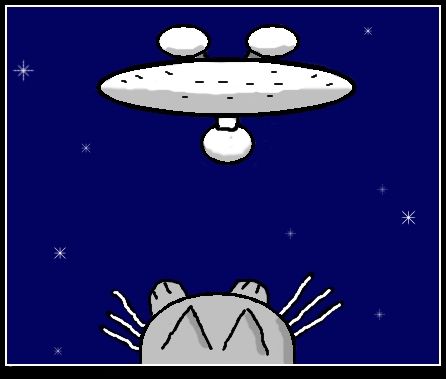
Okay there should be one scene left of the pilot. If you're curious, this is the ship design style I'm picturing for the ship.

aggienaut: (Default)

   Okay am I to adjudge from the lack of comments that no one else finds this as amusing as I do? Well I'm amused and will carry on regardless.


   The town square is half dust, half puddle—an architectural afterthought caught between half-ruined stucco façades, sun-bleached fruit crates, and a rusted water tower scrawled with names no one claims. Overhead, laundry flaps lazily from wire to wire, and a dead moth floats belly-up in a puddle. The Nimrod is nowhere in sight.
   Rafael Panza stands at the edge of it all. His capybara, Sancho, stands beside him, blinking thoughtfully at a nearby cantaloupe. No sign of a ship. Not even a landing strut.
   Nearby, a largish redheaded man with a round head like a jack o lantern and a boyish grin is deep in conversation with a slim, rumpled man in a faded waistcoat. The redhead is all freckled mischief and kinetic shrugging.
   “I’m telling you,” says Rousseau, rubbing his temples. “She looked normal in the profile. I mean okay she was a bit green and her teeth looked a bit sharp but I assumed it was a filter. Girls are always using filters. We agreed to meet at that new romantic Alderaanian restaurant.”
   “And then she was a goblin,” says Ben, delighted.
   “Not metaphorically. A literal goblin. Yellow eyes. Fangs. Small purse.”
   “But was she cute?”
   “Well, kind of menacingly cute, but a dating profile is a sort of social contract and she violated it! And somehow bamboozled me into signing up for a starship!”
   Rafael steps closer, drawn in. “Excuse me. You were recruited by a goblin?”
   Rousseau nods in embarrassment.
   “I think she came for me too,” Rafael says. “Do either of you know where the ship is?”
   Ben’s eyes twinkle with trouble. “Oh sure. You’ll want to head down the alley where the bricks smell like glue. Past the man with the violin case but no violin. Look for a closed door that’s slightly ajar in concept but not in form. Knock three times on the pipe that isn’t connected to anything, and when you hear the sound of a walnut cracking, say the word taxonomy. Then wait.”
   Rafael just blinks.
   Ben beams. “If a woman with an eel on her shoulder offers you tea, say no. That part’s important.”
   “Lies corrode the social contract Ben” Rousseau replies stiffly. ”And didn’t your pranking get you signed up?”
   Ben raises both palms. “Somehow she convinced me, actually got me to think it was my idea, to impersonate a SpaceFleet officer to play a prank on my friend Mick. Had to sign some paperwork of course, and next thing I know I had been tricked into signing on. She said I was ‘culturally compliant with improvisational tasks’ and ‘emotionally desensitized to unnecessary paperwork,’ which—fair. So yeah, I’m crew now. Not sure when we leave. Or how.”
   Rousseau sighs. “Look, the captain is over there." He points to a group across the square.
   “Ask for Captain Kirk,” Ben calls out as Rafael walks away.
   Ahead, near the shade of a flickering old-style viewscreen kiosk, four figures stand deep in argument. They're clad in varying interpretations of the Spacefleet uniform, with the posture of people who were trained to give lectures, not follow orders.
   Socrates, bare-chested beneath his uniform coat, speaks with a bellyful of emphasis.
   Aristotle, sharp-bearded and squinting, gestures with a half-eaten sandwich.
   Plato, wearing a robe and mirrored sunglasses, is carving shapes into the dirt with a stick.
   And Diogenes, lean and sun-withered, sits half-splayed under the kiosk bench, throwing dried peas at pigeons.
   A yellow stray dog lies beside Diogenes, head on its paws, ears flicking in the shade.
   “A hot dog,” Aristotle counters, “is by nature telic—it seeks its own completion. The bun encloses, but does not define.”
   “Is not a sandwich merely a conceptual vehicle?” Socrates is saying
   “It is a sandwich,” says Plato flatly. “But it is a sandwich within the ideal realm.”
   “I’m not saying a hot dog is not a sandwich,” Aristotle argues. “I’m saying it is a liminal food-object that resists binarism.”
   “It doesn’t matter,” says Diogenes. “I’ve eaten both from the same dumpster. They taste the same when you’re free.”
   Rafael stops, Sancho sniffing the dog’s tail. “Excuse me... I was told to speak to Captain Kirk?”
   The philosophers fall silent.
   The dog lifts its head.
   “Yes,” Diogenes says simply. “That’s him.”
   The dog wags once.
   Rafael looks down at it, unsure. “He’s in charge?”
   Diogenes nods. “Well he thinks so and who are we to judge?”
   Rafael glances at the others. Socrates shrugs. Plato scratches the dog’s ear reverently.
   The dog wags its tail once.
   “I was told to join the Nimrod,” Rafael says, cautious now.
   “Ah,” says Plato. “Then you’re one of us.”
   “So… who actually commands the Nimrod?” Rafael asks.
   Diogenes stands, brushing off crumbs. “Command is a fiction. Leadership is a burden. But I do hold the keys.”
   “Do you know where the ship is?”
   They look at each other.
   Diogenes (looking into the distance thoughtfully): “We were too busy asking why, we hadn’t thought to ask where.”
   Socrates (genuinely): “We have determined, through dialectic, where the ship is not. This, I think, is a start.”
   Aristotle (consulting a notebook): “Given its function is to convey officers through space, we can infer it is wherever that function is presently not being enacted. Which… includes here.”
   Plato (gesturing vaguely to the horizon): “We are searching for the Form of the ship. Its shadows are many, but its true berth eludes us.”
   Diogenes (to no one in particular): “Someone mentioned a windmill, but they were unreliable.”
   Rafael (pauses, then): “The person or the windmill?”
   Diogenes (smirks slightly, tosses a pebble at a passing drone): “Yes.”
   Rafael: “…So none of you know.”
   Socrates: “Knowing that we do not know is, in fact, the beginning of knowledge.”
   Diogenes chuckles. The dog barks once.
   Just then, Plato points past the plaza. “There—Ensign Leila N’dere. She remains from the previous crew. She knows.”
   Rafael jogs after her, Sancho trotting loyally behind. The square fades behind him as he catches up to a short woman with an aura of quiet composure about her. Her braids are wound back in a tight, utilitarian crown. She holds a small, pistachio ice cream in one hand, and a digital tablet in the other.
   “Excuse me,” Rafael says, out of breath. “Are you with the Nimrod?”
   “Yes” she says without stopping, “I’m returning to the ship. I wanted fish fingers, which at home are just pieces of chicken,” she complains in a precise and lyrical kenyan accent, but the vendor here gave me actual fingers of some ki–” she sees Sancho and stops. “What is that ... that--” she looks at Rafael, eyes narrowing, gauging how she can describe Sancho without offending Rafael overly much. “… rodent of unusual size?”
   “Sancho. He’s... harmless.”
   She frowns and sighs and continues walking.
   “Why isn’t it parked at the city’s main SpaceFleet landing pad?” Rafael asks.
   “That spot’s allocated to the USS Oversight,” Leila replies dryly.
   “But that ship left months ago.”
   Leila takes a solemn lick of her ice cream. “The allocation remains.”
   Rafael blinks. “That’s absurd.”
   “Compared to other things,” she says. “It’s relatively minor.”
   They walk on, Sancho waddling contentedly behind. Rafael glances back once toward the philosophers, still mid-debate. Diogenes has fallen asleep. Captain Kirk the dog is licking his own foot.
   Rafael is not sure what kind of story he’s walked into.
   But it’s too late now.

aggienaut: (Default)

   Okay so continuing with the Star Trek parodies. As mentioned I've been thinking of actually putting together a series. So I thought I'd make a "pilot episode" for it. Unfortunately, while the AI can get "pretty good" very easily, to polish it up to something actually worth doing anything with is a bit more time consuming. It took me a few hours actually to get this how I wanted it and essentially, the entire plot I wrote myself and fought with it to get how I wanted. But I don't think I'm very good at dialogue and it might be better at that than me. And "Hoodoos" I hadn't thought of the word "hoodoos." Anyway, this is the first scene of the pilot episode. Hopefully when I get back to parodying episodes and have better trained it to this more precise standard it won't take as long or else this entire project which was predicated on taking nearly no time at all certainly won't go anywhere.


   A single perfectly round avocado hangs in the void, suspended at the edge of a branch. It turns slowly, its textured green skin glinting like a miniature planet. The faint sound of wind stirs around it.
   A weathered hand reaches up and plucks it from the branch.
   The tree is struggling—its leaves thin, the bark dull and scarred. The fruit, despite appearances, feels too light. Hollow. Rafael Panza frowns as he turns it over in his palm.
   Beyond the solitary tree stretches a small grove, a handful of low avocado trees huddled near a trickling stream. Around it, the rockscape rises in warped columns and crooked towers, the hoodoos sculpted over millennia by wind and ash. Dust clings to everything. He slices the avocado open.
   The pit rattles inside like a pebble in a shell. No resistance. No heft. A soft sigh escapes him.
   “No fat.” he mutters “No flavor.”
   Still, he lifts a slice to his mouth and chews.
   “Hmm. Metallic.” he swallows “Irony.”
   From the shade beside the water, Sancho the capybara lifts his head and watches with mournful disinterest.
   Rafael tosses the avocado half aside. “It’s either poor pollination... or a goblin.”
   Sancho snorts.
   “I saw yellow eyes,” Rafael says. “Night before last. In the cave. Not a reflection. Watching me.”
   Before the capybara can express skepticism, Jason comes stumbling down the path, one boot in hand.
   “Hey,” he calls. “You seen a shoe? Brown? I lost it helping a woman cross a stream. There was a log. She slipped.”
   “You lost your shoe helping a stranger?”
   “She didn’t fall.”
   “No shoe here,” Rafael says. “Could be downstream. Could be eaten.”
   “Eaten?”
   “Llamas.”
   “Except now I’m down a boot.” Jason glances around.
   “Was it a good shoe?”
   He considers. “No,” he admits. “But I liked the symmetry. How are the trees?”
   “Failing.”
   Jason peers at the grove. “What’s that on the ground?”
   “False fruit.”
   Jason points toward the hoodoo-studded skyline. “Well, SpaceFleet is putting together a crew for a ship that just arrived. They need people. It’s our chance to get out of here!”
   “Need them for what?”
   “Whatever crews do. Fly, scan, poke things. That kind of stuff.”
   Rafael studies him. “What happened to the last crew?”
   Jason shrugs. “I don’t know. Probably not important. Space-mondays man”
   “Can’t you just say Mondays?”
   He offers a two-fingered wave and lumbers back up the path, singing something tuneless. Sancho watches him go, then rolls over with a grunt.
   Rafael looks toward the shadowed opening in the rock wall.
   The cave waits.
   He steps inside.
   The air is cool, tinged with dust and minerals. Light from the entrance stretches across the floor in pale ribbons, leading deeper into the carved interior. The walls curve inward. The silence is old.
   At the far end of the cave, the stone forms a shallow chamber. A flat pedestal rises from the floor, altar-like, bathed in light from the cave entrance. Upon it: a single, perfect avocado. Almost... humming.
   He begins making his way along the uneven surface of the cave. Are those humanoid bones scattered on the floor? Suddenly an enormous shadow looms up against the back wall.
   He quickly tries to scramble back towards the entrance, stumbling over stalagmites. He feels a dagger against his back.
   “I have you now,” a female voice hisses, He carefully turnes his head to see a goblin kneeling over him with a dagger against his back, her large yellow eyes seeming to glow.
   “Rafael Panza.”
   He blinks. “What—”
   “Dirxana. Human Resources. SpaceFleet.” She holds up a flat digital tablet, unreadably lit. “We need you for crew. Your profile shows aptitude.”
   “I never applied.” he explains, as he sits up, now that her dagger is not jabbed in his back. She’s wearing a very professional black knee length dress cinched with a narrow belt.
   “You don’t need to.” She scrolls. “Avocado monoculture, minimal market reach, unflourishing grove – we’ve observed your agricultural work, your survival aptitude, and your peculiar resilience to bureaucratic interference. It’s adequate. You maintain soil chemistry manually. You speak to your fruit. You fixed your irrigation valve with a carved stick. This is exactly the profile we need aboard the USS Nimrod.”
   “I grow avocados. They do not need to be spoken to. I just do it because I’m alone.”
   “That’s what makes you ideal.”
   “Were you sabotaging my avocados??”
   “I didn’t tamper with your avocados,” she says. “Though someone did. I observed during my lunch break, with snacks. If you wish to file a complaint you’ll need form 42-D, but you’ll have to name the person you’re complaining against and that requires form 73-A and I can’t reveal their name to you any way due to the privacy policy.”
   “Are you going to say this is a necessary evil?”
   “Evil is always necessary”
   “Is this how you normally recruit people?”
   “No but this is more fun.”
   “I’m not interested.”
   “Your ex-girlfriend D’vana submitted a post-breakup report. Said you were stuck in a rut. Lacked initiative. Possibly allergic to adventure.”
Rafael stares. “There’s a report?”
   “There’s a report on everything. It’s in your file. So is the thing with the llama, but I’m not judging.” she leans forward “Rafael. Something worse than irony is coming. You won’t stop it from this cave. Or that hill. Or with that capybara. (glances at Sancho) No offense.”
   “Hey it was an alpaca, an unruly alpaca. It ended my career in the alpaca-rodeo but no one could have tamed that beast!”

   Sancho trots in and settles near Rafael’s leg. He blinks, serenely. He’s never had a job, never paid taxes, never been conscripted by goblins. Perhaps he is the wise one.
   “But you didn’t take my avocados?”
   “I don’t even like them,” Dirxana explains again, “I’m more of a jackfruit girl.”
   “What about mangos?”
She shrugs, “The Ataulfo variety is too smug, Haden is overrated in early season, Keitt is dependable but clingy, and Alphonso, devine … but emotionally manipulative. Why?”
Rafael raises an eyebrow. “Testing you. If you really are a good judge of character or are just bullshitting me.”
   “Fair”
   Rafael hesitates. The air in the cave shifts slightly, as though some pressure has lifted. He looks back toward the sunlit entrance, then at the glowing pedestal.
   “Fine,” he says. “I’ll go. But can I have that avocado.”
   Dirxana shrugs. “Take it.”
   He walks forward, hand outstretched. The glow seems to intensify as he nears it. He picks it up.
   It’s cold. Hard. Plastic.
   Dirxana’s laughter echoes through the cave, evil, maniacal and gleeful.


I had actually googled "symptoms of under-pollinated avocados" it's called a "cuke," which word it then inserted but i removed it for sounding too rude 🤣

The "that thing with the llama" line AI came up with and i thought was gloriously hilarious but then i felt at pains to clarify it wasn't a _sexual_ thing lest the reader permanently spoil on this character. And then there was a problem with the "this llama thing" amd the earlier reference to Llamas eating shoes, it feels like too many Llamas but i can't think of a good replacement animal for either.

aggienaut: (Default)

   Continuing to think about Star Trek parodies, I realized "The Orville" is on Disney+ to which we subscribe, which I'd heard was supposed to be a close parody to Star Trek that aims to be irreverent in ways ST can't be. So I watched a few episodes... it wasn't terrible but it just felt like I was watching off-brand temu-Star-Trek, and other than characters trying to make jokes nothing actually funny occurred. And this whole gag that his ex-wife is his first officer is pretty ham-fistedly handled with melodrama in the first episode and thereafter a minor detail. It wasn't terrible, if I had copious amounts of time I wanted to fill with mindless nonsense maybe I'd watch more episodes but I doubt I will because I reserve what time I can spare for concentrated nonsense -- namely, chatgpt writes much funnier scripts than this.

   So since the previous installment I had posted here I've continued to have ChatGPT run my crew of philosophers (and some friends from real life and such) through classic Star Trek episodes, further refining it after each one. A key achievement I think comparing what its writing now with what I had posted before is less completely random funny pseudo-gibberish -- its gradually getting more coherent. There were a few really funny quotes but when I recently went back to find them I found I can't access the history after only a few episodes back so they may be lost. Anyway here's the latest iteration. The name USS Nimrod was my idea, well, as were a lot of things other than incidental occurrences, it really requires careful guidance to actually get anywhere.

Read more... )

aggienaut: (Default)

   So I was recently playing around with ChatGPT since it's been updated since I last played around with it a bit. While I'm in general horrified about the implications of people using ChatGPT to create content, I wanted to explore its capabilities. It's interesting because while it can create a pretty good little short story on demand, thinking about what said output is _missing_ and trying to push it to improve that is an interesting exercise that probably benefits the human writer.
   To make its answers not just pollyanna imaginings without context, I'd kept all my previous questions to it in one chat and told it directly to reference previous topics as much as possible. I had recently been asking it about the philosophies of various philosophers so they featured prominently which I really liked.

   We'll skip the first few stories which involved Socrates, Diogenes, and some other characters in ancient Greece trying to thwart Eloncles, a musk merchant (see what I did there? ChatGPT, otherwise insightful, refuses to make any connections) attempting to import various products with dire biosecurity consequences (I told you its based significantly on previous conversations I'd had with it). Originally "a squirrel farmer" was a background character and then I suggested the already introduced scheming merchant was dealing in musk from these squirrels. In the last iteration before we travel to space the musk had taken on some interesting properties akin to the Spice Melange of Frank Herbert's Dune series. Anyway the following results I think are entertaining and ultimately had me laughing to hard I had tears in my eyes.

   We'll begin wherein I've asked it to put noted philosopher, founder of "cynism" Diogenes, in the "unwinnable situation" from Star Trek, the Kobayashi Maru scenario. I'll make occasional changes to its version with [] brackets.

Philosophers In Space )


   And what conclusions can we draw from this about the future of AI and AI assisted writing? Well I think it can create interesting content that is worth reading but only with careful prompting. Generally any attempts to make it write something without a lot of steering has created content that's just dumb and pollyanna. I certainly wouldn't have been able to make all this in just a few collective minutes (this was through the day I'd have it make me an interation and then spend the next hour or two carefully thinking how I could steer it then next direction while otherwise going through my workday and then take a moment to give it the next prompt), but the fact that this could go on forever highlights another fundamental thing about writing -- it needs curation. People don't have infinite time to read things, human producers of writing were forced to curate because of the time involved, tehy'd carefully produce the best they could in the time available, with AI content creation one could create a firehose of content, and it would still take a human to make the cuts to present an audience with the appropriate amount of it. And, well, that's promising for me as an editor.


See also, previous (drawn) zany adventures in space.

aggienaut: (Default)
So ereyesterday I had discovered the beautiful art of Robert Walsh, which I thought would be nice to illustrate The Apinautica. It further occurred to me that my moral objections to AI don't apply so much to art that is based on stuff already in the public domain, so let's see if the AI can create art in the style of Robert Walsh. I consulted my computer savvy friend Mick and he recommended bing copilot as being free and able to be used immediately. We begin with already its third attempt at Cappadocia:

20240507-WA0018.jpeg

20240507-WA0018.jpeg


   Look at that, it knows what it's done! I haven't even brought up hot air balloons and its immediately making excuses!!


   At this point I gave up. I suppose its gratifying really to find that it seems, at least if this AI is representative of others, that it cannot seem to make art that doesn't "look like AI," mimic a specific artist's style well, or, apparently, resist the uncontrollable urge to include hot air balloons.

   Also I realize there's no reason to be polite to the AI but I rather feel like how you address even the AI reflects upon yourself. I'd feel dirty just shouting orders at it.

Wait, one more!

aggienaut: (Default)

   The classics of science fiction such as Asimov always envisioned robots that were physically more capable than humans, more precise at mathemetical calculations, but faced with an unsurmountable challenge to match humanity in the creative arts. How ironic it is then, that they seem to have achieved the latter first. The surprising ability of "chatgpt" to produce human-like writing to match any prompt has been making the news for the last two or three weeks, and a popular science fiction publisher has had to stop taking submissions due to the inundation of submissions of AI generated content. Similarly pictures, "paintings" or "photographs" and everything in between, can also be generated by AI now to a degree that can usually pass for non-AI content (see also, headline today: instagram-famous photographer confesses he's been using AI to generate the "photos"). Weirdly, AI's one weakness seems to be that it keeps giving people too many fingers -- I've never understood how captchas (identify the boxes with crosswalks or garbled letters I can barely decipher after several tries) are somehow too much for computers to handle (they seem like tasks AI image recognition would actually be better than people at), but maybe the secret is to make the user draw a hand. Anyway, I for one am in great fear of our new polydactyl overlords.


   Back when robots were just taking physical jobs it wasn't much of a bad thing really. There were some fears of it causing unemployment sure, but in theory society should be able to find those people new more fulfilling jobs or maybe look after them with a universal income -- it's hard to stand back and say repetitive jobs being lost to robots is a bad thing. Future dystopias, always a popular genre, usually focused on the robots taking over and becoming evil and either enslaving people (for some reason), or just declaring that they are an unnecessary and inefficient bother or something.
   The alternative, the course we seem to actually be on (of course we're on the unimaginably-worse-than-they-imagined timeline, because of course we are), is that AI will actually replace _creative_ occupations and hobbies first. We still don't have the fun anthropoid robots the sci fi promised us walking around being helpful, but if trying to find success in creative writing or art wasn't already hard enough now we will be inundated by AI technology that is looking like it may soon be better at it than us.

   And not only that. I already get whatsapp messages from people, representing themselves to be cute girls in Singapore usually, saying they "accidentally" messaged me by wrong number and trying to befriend me while also urging me to invest in crypto. Right now I assume there's actual humans on a keyboard at the other end (I picture a particularly hairy man). I'm sure the mass use of AI "conversation making" technology by chatbots is just around the corner. And I doubt they'll limit themselves to "accidentally messaging a wrong number." They'll be lurking around playing games, posting content on instagram, basically floating around the internet acting like people. I envision an alarming time in the not too distant future where unless you actually meet someone in person you literally can't be sure they're a real person.


   I feel like someone needs to write a new great science fiction novel about this new dystopia we're headed into ... before a computer writes it first.

March 2026

S M T W T F S
1234567
891011 121314
15161718192021
22232425262728
293031    

Syndicate

RSS Atom

Most Popular Tags

Style Credit

Expand Cut Tags

No cut tags
Page generated Mar. 14th, 2026 06:32 pm
Powered by Dreamwidth Studios